


The most reliable sensor in an amusement park is the one you never think about — because it works every time, all season long, without demanding attention between scheduled maintenance intervals. Selecting the right sensing technology for each specific ride application, installing it correctly, and maintaining it on a defined schedule are the three practices that separate rides with exceptional uptime from those that frequently go down for sensor-related issues.
This guide covers the evaluation process for ride sensor applications, the two dominant sensing technologies used in the amusement industry, and the maintenance approach that maximizes return on the investment in quality sensing hardware.
Evaluating Each Ride Individually
No two rides have identical sensing requirements. A dark ride uses sensors in very different conditions than a roller coaster or a log flume. Each ride must be evaluated on its own merits, with the selection driven by the specific application requirements rather than convenience or familiarity with a particular product.
For each sensing position on a ride, ask:
- What must the sensor detect? — metal parts, wooden structures, vehicle bodies, water levels, positions?
- What are the environmental conditions? — wet, dry, outdoor, indoor, dusty, dark, temperature extremes?
- What is the sensing distance required? — close range, across a track width, across a water channel?
- What is the consequence of a false positive? — nuisance stop, or a safety-critical response?
- What is the consequence of a missed detection? — potential collision, safety hazard, or guest experience issue?
- How accessible is the mounting location? — how difficult and costly is it to replace or adjust a sensor at this position?
These questions narrow the field to the appropriate sensing technology and product category for each position.
Eliminating Contact Switches
Wherever mechanical limit switches (contact switches) are currently in use on a ride, evaluate whether they can be replaced with non-contact sensors. Contact switches have moving parts — an actuator arm, a return spring, and electrical contacts — all of which wear out under repeated mechanical actuation. In a busy amusement park, a sensing position that actuates hundreds or thousands of times per day will wear out a mechanical switch far faster than the manufacturer's rated life cycle suggests, because catalog life ratings are based on low-duty-cycle switching rather than the demanding continuous operation of a park attraction.
Non-contact sensors — photoelectric and inductive proximity — have no moving parts that wear from detection. The sensor head detects by sensing changes in light or electromagnetic fields, with no mechanical contact between the sensor and the detected object. Barring physical damage, exposure to conditions outside the sensor's rated parameters, or end of electronic component life, non-contact sensors outlast contact switches in high-cycle applications by a significant margin.
Infrared Photoelectric Sensors for Ride Applications
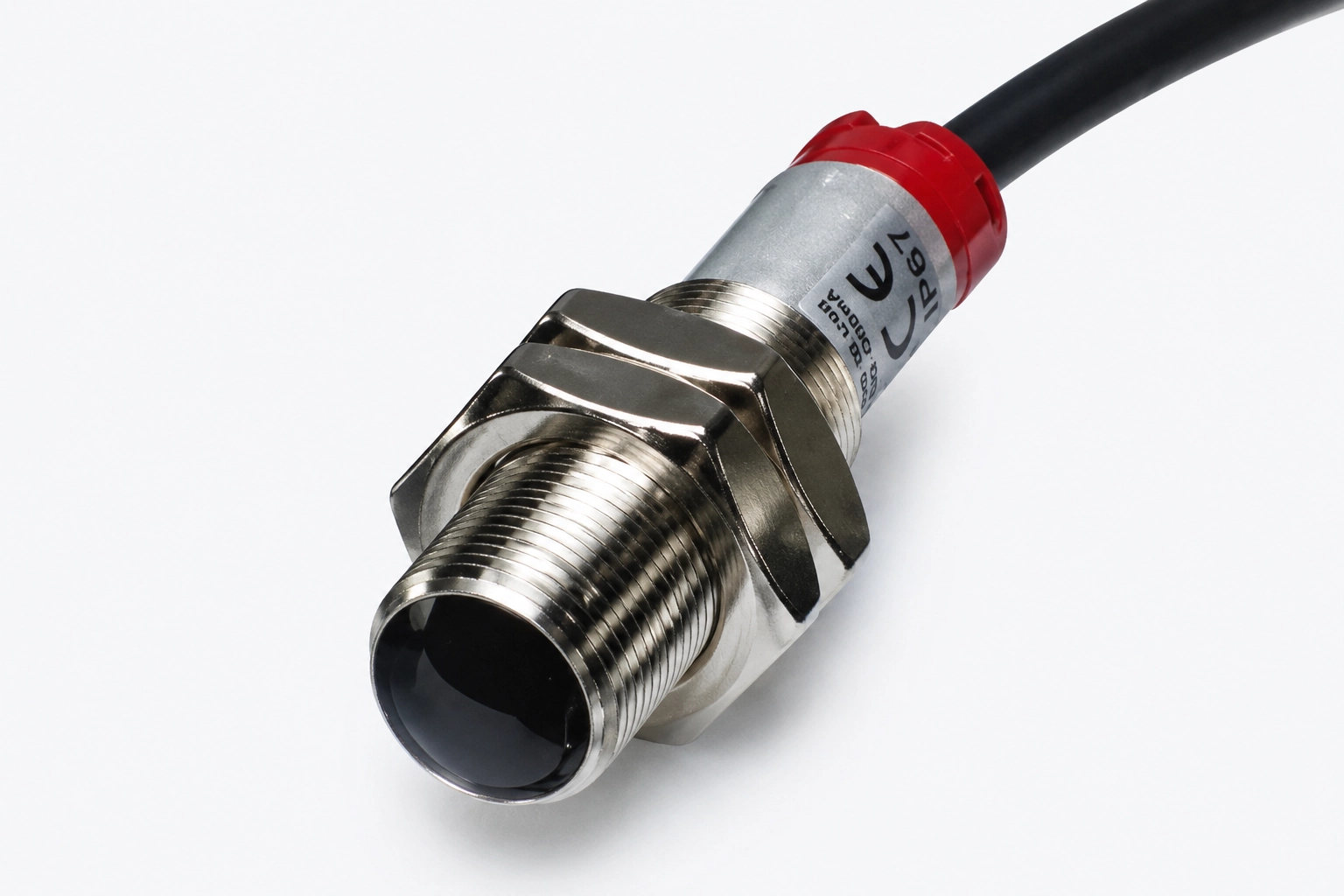
Infrared photoelectric sensors excel in ride applications that require detection over a distance, detection of non-metallic objects, or detection in environments where the sensor cannot be positioned in close contact with the detected object.
Ideal Applications for Photoelectric Sensors
Log flume and water rides — detecting boats and vehicles across a water channel requires sensing at a distance, in a high-moisture environment, through potential mist and spray. Through-beam photoelectric sensors with IP67 or IP68 ratings and high-output infrared emitters are the correct choice. Stainless-steel housings resist the chemical water treatment used in ride water systems.
Dark rides and themed attractions — detecting vehicles in enclosed, darkened environments where position tracking is needed for special effect triggers or safety zones. Infrared operates independently of ambient light conditions — it works equally well in complete darkness and in bright light.
Themed water effects and animatronic triggers — triggering specific effects as a vehicle passes a defined point in the ride path. Photoelectric sensors provide precise, repeatable trigger points and respond fast enough to trigger effects at the correct moment even at higher vehicle speeds.
Overhead detection — detecting objects at heights or across distances where inductive proximity sensing is impractical due to sensing range limitations.
Selecting the Right Photoelectric System
For all ride applications:
- Specify IP67 minimum for any outdoor or water-adjacent installation
- Use through-beam configuration — it provides the strongest beam and requires no reflector to maintain
- Select high-power sensor systems to build in reserve margin against environmental attenuation of the beam
- Prefer stainless-steel or UV-stabilized plastic housings over standard plastic for long outdoor service life
- Consider quick-disconnect wiring for easily accessed locations to simplify annual replacement
Inductive Proximity Sensors for Ride Applications
Inductive proximity sensors detect metallic objects at close range without contact, making them extremely well-suited for applications where the detected object is a metal part of the ride vehicle or track, and where the sensor can be mounted within the typical sensing range of 2-30mm (depending on sensor type and target material).
Ideal Applications for Inductive Proximity Sensors
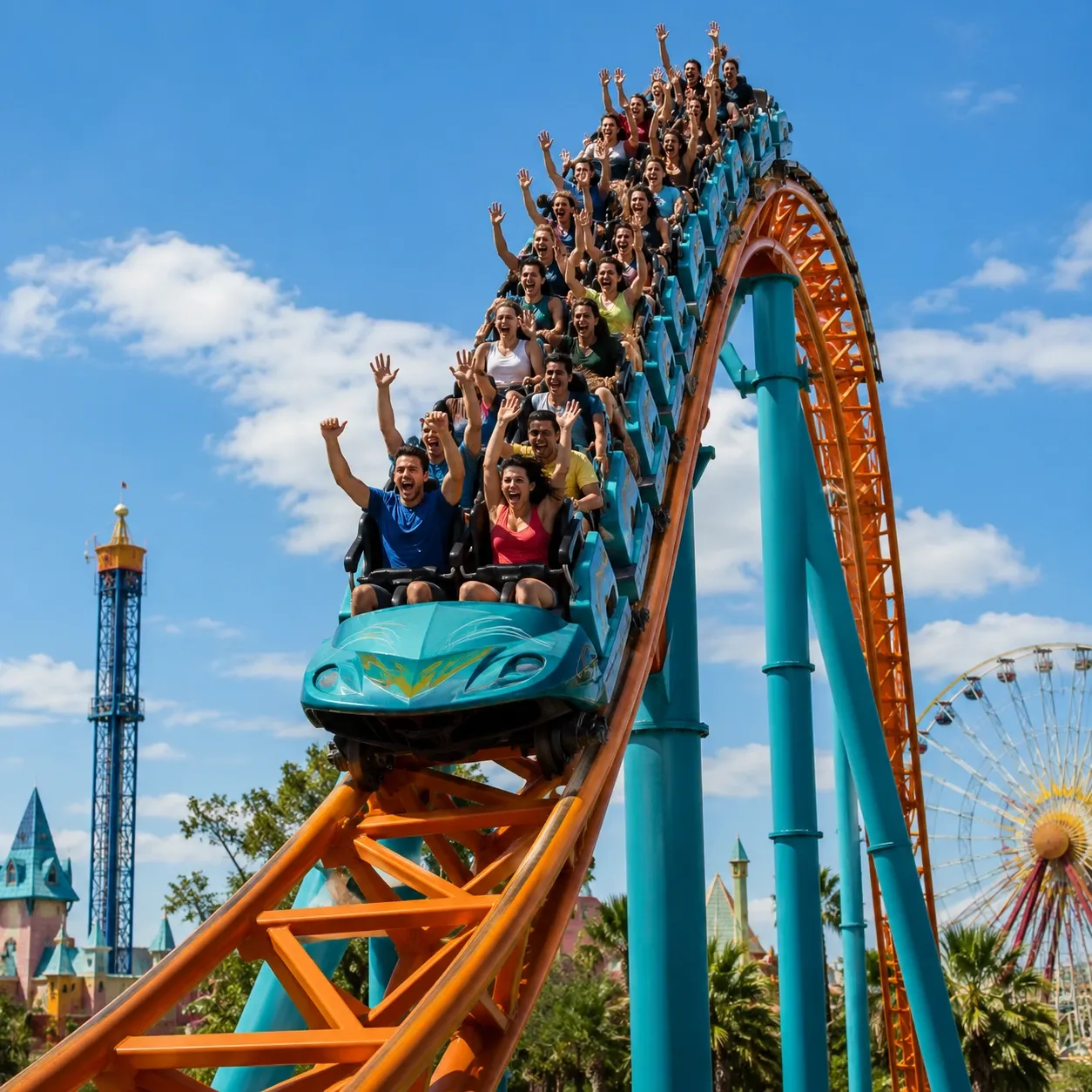
Roller coasters — detecting the metal in roller coaster trains as they pass designated positions along the track. Sensors mounted to the track structure detect the metallic undercarriage of each car as it passes. Inductive proximity sensors are a natural and proven replacement for the mechanical limit switches traditionally used for this purpose.
Vehicle presence detection on loading platforms — confirming that a ride vehicle is correctly positioned in the station before loading and unloading begins. The consistency of the inductive sensor's switch point makes it reliable for precision positioning confirmation.
Chain dog and anti-rollback detection — detecting the engagement and position of mechanical lift chain components made from ferrous metal.
Drive system monitoring — detecting the rotation or position of metal components in the ride's drive train for maintenance monitoring and safety interlock functions.
Selecting Inductive Proximity Sensors for Rides
For outdoor ride applications:
- IP67 or higher for weather resistance
- Full metal housing (stainless steel or nickel-plated brass) for resistance to physical impact — a sensor mounted on a roller coaster track will occasionally be struck by debris, and a metal housing survives contact that destroys a plastic-housed sensor
- Flush-mountable models where the sensor must be installed in a metal bracket flush with the bracket face, to protect it from direct contact with the detected object
- Vibration-resistant designs — rides generate significant vibration; confirm the sensor's vibration specification is appropriate
The Annual Replacement Strategy
Many amusement parks achieve their best sensor reliability not by trying to maximize the service life of each individual sensor, but by adopting a scheduled annual replacement program.
The logic is straightforward: a sensor that has operated through a full park season has experienced weather extremes, thousands of actuations, vibration, UV exposure, chemical and moisture exposure, and the general wear of a demanding operating environment. Rather than waiting for that sensor to fail in-season — during peak operating hours when the ride is generating maximum revenue — replace it before the new season opens.
At the annual replacement interval:
- Replace all sensors of the same model and type throughout the ride
- Verify alignment and output of every sensing position before opening to guests
- Inspect and replace cable assemblies showing wear on the jacket or at connector points
- Update documentation with the replacement dates and any changes made
This approach converts the sensor cost from an unpredictable emergency expense into a planned maintenance line item. The improvement in ride uptime and the reduction in emergency calls for maintenance staff to address in-season sensor failures typically delivers a net cost benefit even when the cost of the annual sensor sets is considered.
Working with Manufacturers and Distributors
Any sensor manufacturer or distributor genuinely interested in earning and maintaining the business of an amusement operator should be willing to support the application with more than just a product. Expect your supplier to provide:
- Application engineering assistance in selecting the correct sensor for each position
- Demo products for evaluation in the actual ride environment before committing to a large purchase
- Technical support for troubleshooting when problems arise
- Training for maintenance staff on sensor characteristics, adjustment procedures, and basic troubleshooting
Pantron Automation provides this level of application support for the sensor products it distributes, including high-power infrared photoelectric systems and the full range of inductive proximity switches appropriate for ride and attraction applications.