


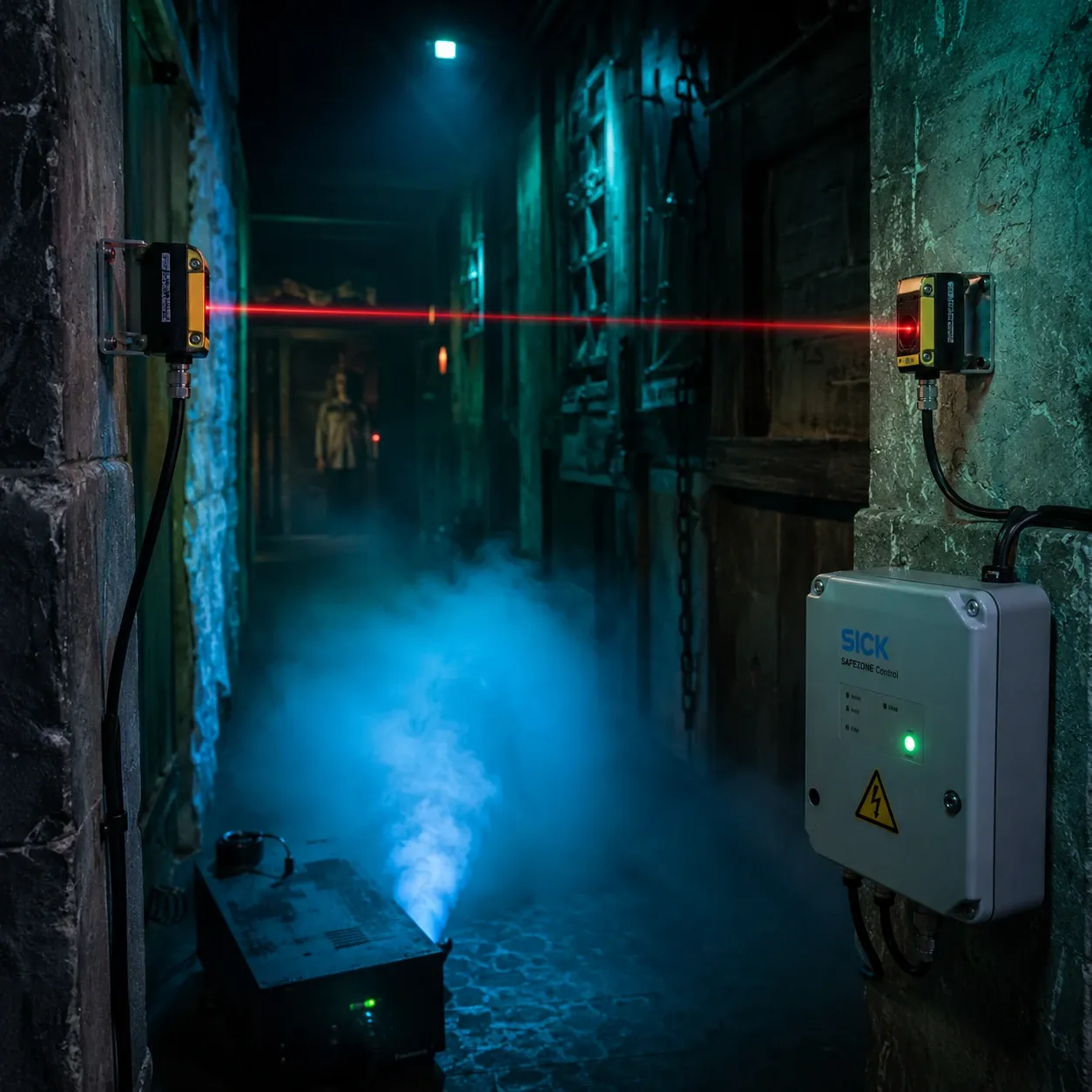
Haunted house attractions rely on surprise and timing to deliver memorable experiences. A skilled cast of performers can be highly effective, but even the best staffed attraction faces limitations — performers get tired, they cannot be in multiple places simultaneously, and their timing will inevitably vary. Industrial-grade infrared photoelectric sensors offer a reliable, non-contact method to detect guests and trigger electronic scare devices automatically, delivering consistent scares without depending on human intervention at every trigger point.
Why Industrial Sensors for Entertainment?
Photoelectric sensors are designed for 24-hour-a-day, 7-day-a-week operation in demanding factory environments. They are engineered to detect objects reliably, respond instantly, and do so tens of millions of times without mechanical failure. These characteristics translate directly into haunted house applications: the sensor detects a guest, triggers a device, resets, and waits for the next guest — all without any operator involvement.
Some of the top commercial haunted attractions in the country use the very same sensors found on automotive assembly lines and food processing conveyors. The sensors are readily available to any buyer, and their cost is lower than many people expect. With the right sensor and a basic understanding of wiring, an average person can build a level of automation that rivals what is seen at major theme parks.
Choosing the Right Sensor
Use a Relay Output Sensor
The easiest type of photoelectric sensor to use in a haunted house is one equipped with a built-in mechanical relay output. A relay output works like a simple electrical switch — when the sensor detects a guest, the relay closes, completing a circuit and providing power to whatever device is connected. This is conceptually identical to a light switch, and the wiring is just as straightforward.
Many industrial photoelectric sensors have transistor outputs (NPN or PNP) rather than relay outputs. While transistor outputs are suitable for interfacing with PLCs and other industrial controllers, they are not ideal for directly powering noise makers, lighting effects, or animatronics without additional interface components. A relay output sensor eliminates the need for that extra step.
Infrared Light Only
Choose sensors that operate on infrared light, not visible light. Visible-beam sensors display a red dot where the beam lands, which would immediately reveal the sensor's position to approaching guests and spoil the effect. Infrared light is invisible to the human eye, keeping the sensor completely concealed within the environment.
Through-Beam Configuration
Mount one sensor on each side of a corridor, doorway, or any space where guests must pass. The through-beam (also called opposed-mode) configuration places the transmitter on one side and the receiver on the other, projecting an invisible beam across the path. When a guest walks through, they break the beam, triggering the relay output and activating the connected effect.
This configuration is more reliable than diffuse or retro-reflective arrangements in haunted house environments because it provides the strongest beam and is least affected by the unpredictable surfaces, colors, and clothing of passing guests.
Timed Relay Amplifiers
For many haunted house effects, a simple on/off trigger is sufficient. But for animatronic characters, timed air blasts, or lighting chases, a timed relay amplifier is extremely useful. Timed amplifiers can be configured to hold the relay output for a fixed duration after the beam is broken — allowing a device to run for a set number of seconds regardless of how quickly the guest passes through the beam. This prevents effects from cutting off prematurely if someone walks through the beam very quickly.
Practical Setup Guide
Step 1: Identify Trigger Locations
Walk through the attraction and mark every location where an automated effect would enhance the experience. Consider:
- Corridor segments where guests are funneled single-file
- Doorways and entry points into new rooms
- Hallways with narrow passages
- Any location where a timed delay would allow a performer to get into position behind a guest
Step 2: Select and Mount the Sensors
For each trigger location, install a transmitter photo eye on one side and a receiver photo eye directly across. Mount them at a height that will intercept the majority of guests — approximately waist to chest height works well for most adult attractions. Keep the sensors in inconspicuous locations: inside props, behind mesh, or recessed into walls.
Step 3: Wire to the Scare Device
Connect the relay output from the sensor or timed amplifier to the power circuit of the scare device — a noise maker, motorized animatronic character, pneumatic air valve, or lighting controller. Most relay outputs can handle line voltage directly, but always confirm the relay's current and voltage ratings against the load requirements of the device being controlled. When in doubt, use the sensor relay to trigger a larger relay or contactor sized appropriately for the load.
Step 4: Test with Live Guests
Walk through the attraction repeatedly at different speeds and from different angles to verify that the sensors trigger reliably. Adjust sensitivity settings on the amplifiers if needed. Test the timing of timed relays to ensure effects run for an appropriate duration.
Step 5: Conceal the Installation
Once all sensors are adjusted and performing correctly, conceal cables in conduit or raceways and hide sensor bodies within the scene elements. A well-hidden sensor is completely invisible to guests, maintaining the immersive quality of the attraction.
Benefits Over Human-Only Staffing
- Consistency — the sensor triggers at exactly the same moment every time, without the variability of human timing
- Scalability — a single staff member can manage a much larger attraction when repetitive trigger duties are handled automatically
- Endurance — automated effects do not get tired, lose focus, or need breaks; they perform identically at hour one and hour ten
- Flexibility — performers are freed to focus on guest interaction, personalized scares, and the elements that benefit most from a human touch
- Cost efficiency — a one-time investment in sensors and effects delivers repeatable value across multiple seasons
Industrial photoelectric sensors bring the same reliability that keeps factory production lines running to the haunted attraction environment. The result is a more polished, more consistent, and ultimately scarier experience for every guest who walks through.