


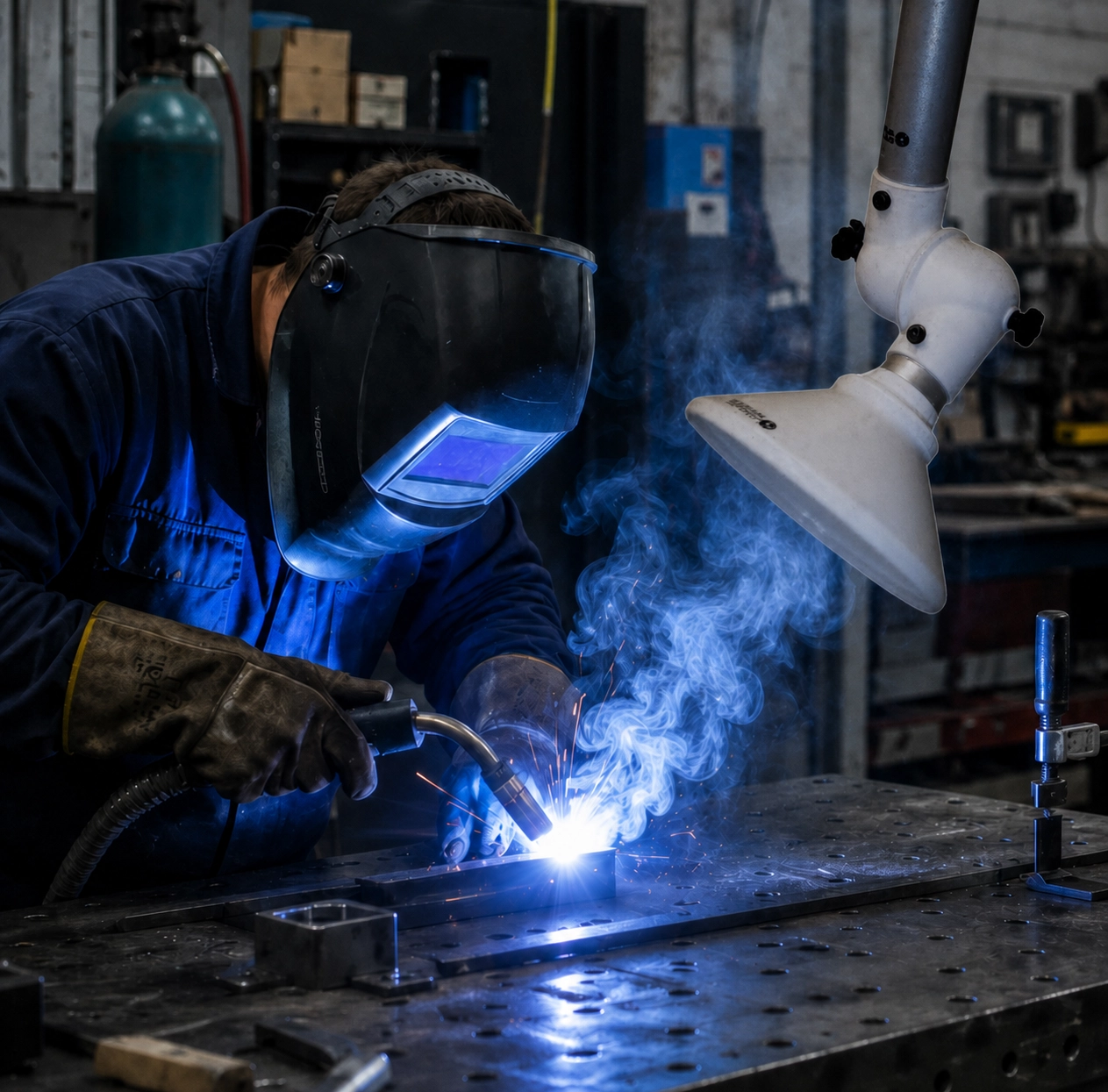
Industrial processes that involve heat, combustion, chemical reactions, or material transformation frequently generate harmful airborne contaminants. Welding fumes, laser cutting emissions, soldering vapors, grinding dust, and chemical off-gassing are among the most common examples. Without proper extraction and filtration, these contaminants accumulate in the workplace air and expose employees to serious health risks — including respiratory disease, occupational asthma, toxic metal poisoning, and in extreme cases, cancer from long-term exposure.
Effective air extraction and filtration is not optional — it is a fundamental component of a responsible, compliant, and productive industrial operation.
Understanding the Hazards
Different industrial processes generate different types of airborne hazards:
Welding and cutting — metal arc welding generates fumes containing iron oxide, manganese, chromium, nickel, and other heavy metals, depending on the base material and consumables. MIG, TIG, stick, plasma, and laser processes each have distinct fume compositions. Many of these components are classified as occupational carcinogens.
Laser processing — laser cutting and engraving of metals, plastics, wood, and composites produces fine particulate matter and volatile organic compounds (VOCs) that are potentially toxic depending on the substrate material. Laser fumes from certain plastics can contain highly dangerous compounds including hydrogen cyanide and benzene derivatives.
Soldering — hand soldering and wave soldering with flux-cored solder generate rosin fumes (colophony) and other flux decomposition products that are a leading cause of occupational asthma in electronics manufacturing.
Grinding and machining — grinding operations produce fine metal particles and abrasive dust; machining with cutting fluids generates oil mist aerosols that coat lungs and surfaces throughout the facility.
Chemical processes — adhesive bonding, coating, painting, and surface treatment processes release solvents, isocyanates, and other VOCs into the workplace air.
General dust — woodworking, textiles, food processing, and pharmaceutical manufacturing generate fine particulate matter that poses both respiratory health risks and, in some cases, explosion hazards.
The Importance of Source Capture
The most effective approach to industrial fume and dust control is source capture — extracting contaminated air as close to the point of generation as possible, before it disperses into the general workplace air. A fume extractor positioned at the workstation captures the majority of contaminants at their source, dramatically reducing the concentration that reaches the worker's breathing zone and the general shop environment.
Relying on general ventilation alone — opening doors, running overhead fans, or providing general HVAC — is not an adequate substitute for source capture in applications with significant fume or dust generation. General ventilation dilutes contaminants rather than removing them; it also spreads contamination throughout the facility rather than containing it at the source.
Selecting an Air Extraction and Filtration System
The correct extraction and filtration system for a given application depends on the type, volume, and chemical composition of the contaminants being generated, as well as the physical configuration of the workstation and the production environment.
Fume Extractors for Individual Workstations
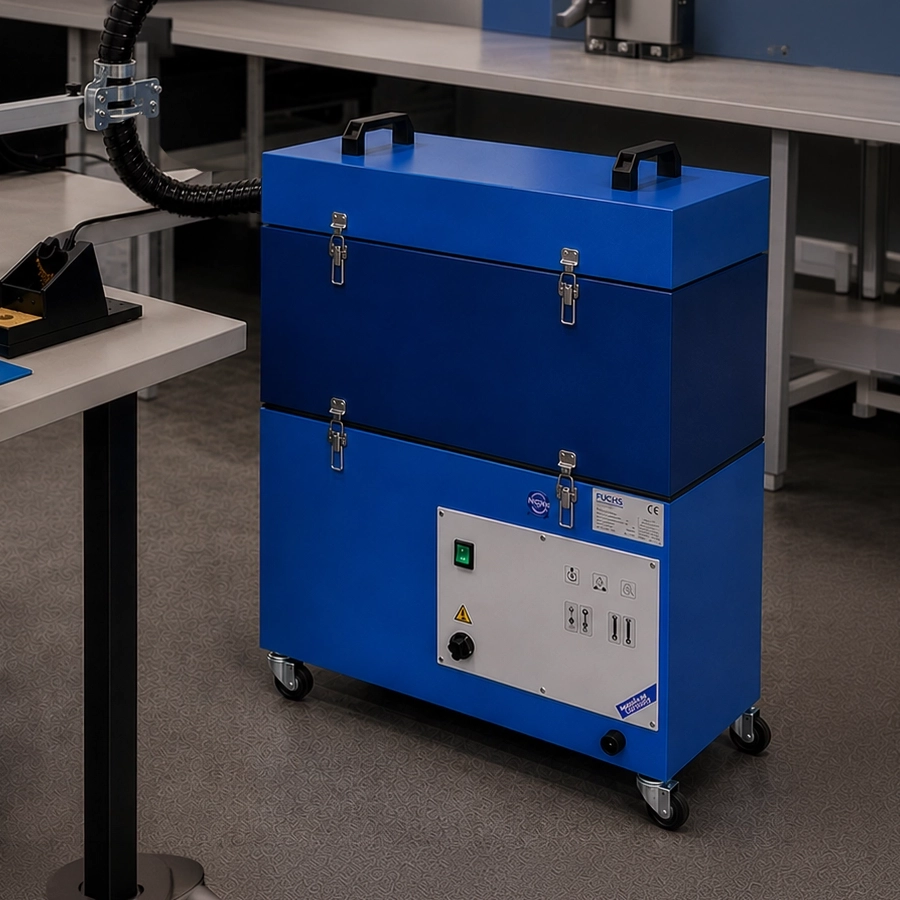
Single-station portable or stationary extractors are appropriate for individual welding stations, soldering benches, or laser processing cells. These units draw contaminated air through a flexible capture arm or hood positioned near the work, pass it through a multi-stage filtration system, and return clean air to the work environment. Key filtration stages typically include:
- Pre-filter — captures large particles and protects downstream filter stages
- Main particulate filter — high-efficiency filter (HEPA or equivalent) that removes fine metallic particles and dust
- Activated carbon filter — adsorbs gases, vapors, and odors including VOCs, solvent vapors, and ozone
The correct combination of filters must be matched to the specific contaminants generated. A system optimized for welding fumes, for example, may not adequately capture solvent vapors without an appropriate activated carbon stage.
Centralized Extraction Systems
For facilities with multiple workstations generating similar contaminants, a centralized extraction system with a network of capture hoods connected to a central filtration unit may be more practical than individual extractors at each station. Centralized systems can often be designed to handle higher volumes and may incorporate more sophisticated filtration stages suited to the specific application.
Matching the Machine to the Application
Many air filtration equipment manufacturers — including Fuchs Umwelttechnik (Fox Environmental Technology), whose products are available through Pantron Automation — offer application engineering support to help select the correct system for each situation. Their websites typically include selection tools that guide the user through questions about process type, material, production volume, and workspace layout to recommend the appropriate extraction capacity and filter combination.
Take advantage of this support before purchasing. Installing the wrong system wastes capital and may leave employees inadequately protected. An undersized extractor cannot keep pace with the contaminant generation rate; an extractor with the wrong filter combination may capture particles but allow harmful gases to pass through.
Installation Considerations
Follow Manufacturer Specifications
Air extraction and filtration systems must be installed strictly in accordance with the manufacturer's instructions. Improper installation — incorrect mounting position, inadequate supply air, incorrect electrical connection, or improper duct routing — can prevent the system from performing to specification and may create safety hazards. If there is any uncertainty about the installation procedure, contact the manufacturer or a qualified service technician before proceeding.
Maintain Adequate Supply Air
Extraction systems remove air from the workspace and must be able to replace it. If the facility is tightly sealed and insufficient makeup air is provided, extraction effectiveness will be compromised as negative pressure builds up in the workspace. Ensure that the facility HVAC system or dedicated makeup air supply can compensate for the volume being extracted.
Filter Replacement Stock
Keep a supply of replacement filters on hand at all times. The temptation to operate a fume extractor with a saturated or missing filter because a replacement is not immediately available represents a real and preventable occupational health hazard. A saturated filter passes contaminants back into the workspace air; an extractor operating without its filters provides no protection at all. Establish a filter replacement schedule based on the manufacturer's guidance and the actual usage conditions, and replenish stock before it runs out.
Maintenance and Filter Replacement
Air extraction and filtration systems require regular maintenance to continue performing effectively:
Filter inspection and replacement — follow the manufacturer's recommended replacement interval as a starting point, but also monitor filter saturation indicators if provided. Heavy usage or particularly contaminated processes may require more frequent replacement than the manufacturer's baseline schedule. Some systems include differential pressure sensors or dedicated filter saturation indicators that alert operators when the filter restriction has reached a replacement threshold.
Capture arm and hood maintenance — flexible capture arms need periodic inspection for kinks, cracks, or blockages that reduce airflow. Hoods and nozzles should be kept clean and positioned correctly relative to the work.
Motor and blower maintenance — follow the manufacturer's maintenance schedule for the extraction unit's motor and impeller, including lubrication intervals and brush replacement on brush motors.
Discharge verification — units that discharge filtered air back into the workspace (recirculating mode) should be periodically tested to confirm filter integrity and performance. Units that discharge to the outdoors should have their exhaust connections inspected for air tightness.
Proper application of air extraction and filtration technology is one of the most important investments an industrial facility can make in the health and wellbeing of its workforce — and in the long-term productivity and compliance of its operations.